Showing posts with label Amazing Animals. Show all posts

Thursday, February 23, 2012

Komodo Dragon, The Giant Lizard

komodo dragon

komodo dragon

komodo dragon eat

komodo dragon mouth

komodo dragon egg

komodo dragon baby
Komodo dragons (Varanus komodoensis) are the largest living species of lizard. Their size can reach 3 meters (10 feet) in length and weigh up to 300 lbs (136 kg). These giant lizards can be found in the Indonesian islands of Komodo, Flores, Rinca, Gili Motang and Gili Dasami.
Unlike most others lizards which are omnivores, Komodo dragons are carnivores. They eat almost everything, deer, wild buffalo, snakes, fish, and even carrion. Komodo dragons have clay-colored, scaly skin. Its help them to camouflage during hunting. Patiently, Komodo dragons wait for passing prey. When a victim approaches, the dragon attack with its powerful legs, sharp claws and teeth. When the prey got bitten by komodo, it doesn’t matter if it escapes. It’s because dragon’s bite contains deadly bacteria, and within 24 hours, the wounded prey usually dies of blood poisoning. The dragon simply follows an escapee as the bacteria take effect using its tongue to pick up smells.

Platypus, The Egg-Laying Mammal

platypus, the egg-laying mammal

platypus, the egg-laying mammal

platypus, the egg-laying mammal

platypus, the egg-laying mammal

platypus, the egg-laying mammal
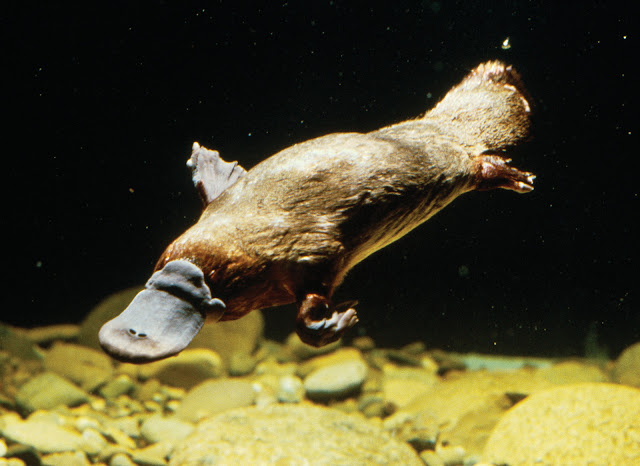
The platypus (Ornithorhynchus anatinus) is a rare animal. The bizarre appearance of this duck-billed, beaver-tailed, and otter-furred mammal baffled the scientists when they first examined it. Even they thought that it’s just an elaborate fraud. The platypus is an endemic to eastern Australia and this mammal is one of two mammals that lay eggs instead of giving birth to live young. The males are also venomous. The sharp stingers on the heels of their rear feet are used to deliver a strong toxic that cause severe pain to humans. The platypuses have 3 lbs (1.4 kg) in weight and about 50 cm (20 in) length from head to tail.
Platypuses are great swimmer and spend much of its time in the water foraging for food. They used their front webbed feet for paddling and their hind feet and beaverlike tail for steering. Their eyes and ears were covered with folds of skin to prevent water from entering, and the nostrils close with watertight seal. A platypus can remain submerged for a minute or two.
They hunt underwater. With their sensitive bill, they scoop up insects and larvae, selfish, and worms along with bits of gravel and mud from the bottom. They stored all this material in cheek pouches and, at the surface, mashed for consumption. Platypuses don’t have teeth, so the bits of gravel help them to digest their meal. When platypuses on land, the webbing on their feet retracts to expose individual nails and allow them to run.
The platypus lives in a simple ground burrow whose entrance is about 30 cm (12 in) above the water level. Females lay their eggs inside one of the burrow’s chamber. The female constructs a deeper, more elaborate burrow up to 20 m (66 ft) long and blocked at intervals with plugs, which may act as a safeguard against rising waters or predators, or as a method of regulating humidity and temperature. The eggs hatch in about ten days. The newly hatched young are vulnerable, blind, and hairless, and are fed by the mother's milk. Females nurse their young for three to four months until the babies can swim on their own.